About Sounds for Sisterhood
A social enterprise project
At the heart of this project is the belief that rest, care, and nervous system support should not be out of reach for the women who need it most.
Each paid session helps make a complimentary session possible for another woman through the pay-it-forward model.
The sessions themselves take place in a calm, private setting, offering space to soften, settle and receive.
About the bowls
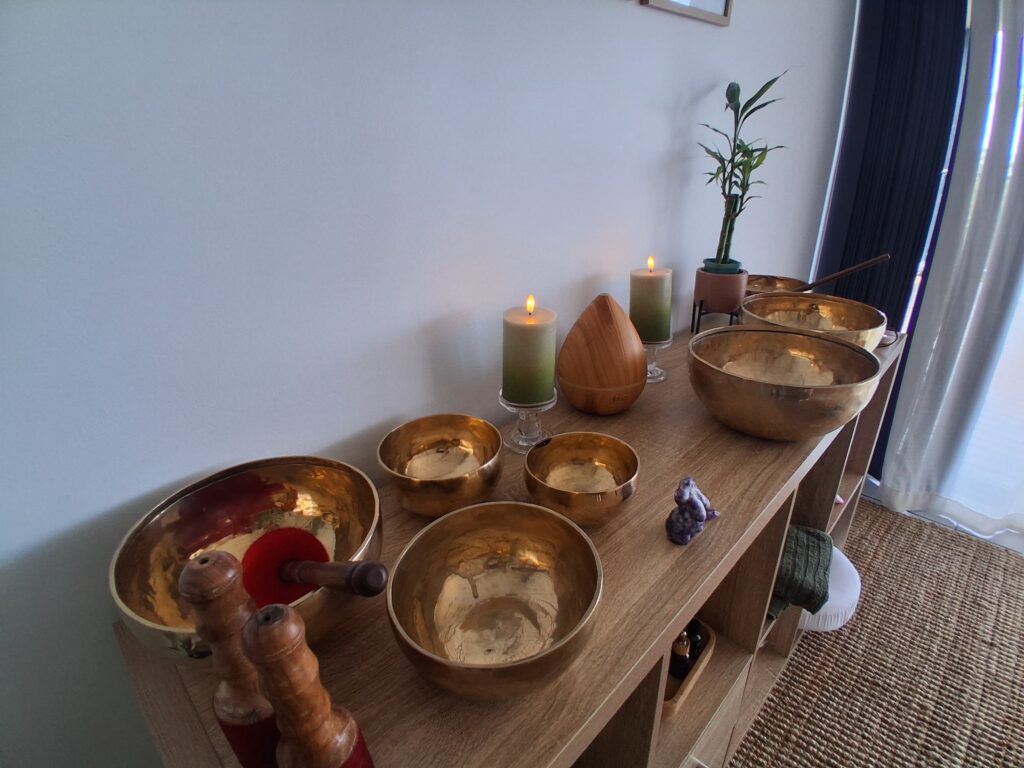
The bowls used at Sounds for Sisterhood were chosen slowly and with care.
I learned under the guidance of Yogi Bhanu at the Himalayan Academy of Sound in Rishikesh, where I deepened my understanding of traditional sound practices. It was also there that I selected the Himalayan bowls I now use in session, listening for the quality of each one and how they sat together as a set.
Each bowl was chosen to work in harmony with the next, creating a sequence of tones that feels grounded, balanced, and deeply soothing to the body. I was also listening for a particular sequence of notes, so the whole set would feel harmonious to play.
My bowls sit in a lower register, which means the sound tends to feel fuller, warmer, and more settling than higher, brighter tones. Many people notice that they can feel the vibration as much as hear it, almost like gentle waves moving through the body.
It’s something clients notice too. Many are drawn to the lower bowls, often describing them as the ones they can feel most clearly, moving through the body in a way that feels grounding and calming.
Traditional Himalayan bowls are shaped by hand through repeated heating and hammering, using traditional metal alloys that give them their earthy warmth, depth, and resonance. Each one carries a main tone, along with softer harmonic layers that continue to shimmer underneath it.
That richness is part of what makes them so beautiful to work with. They feel textured, alive, and full of warmth.
What is Reiki
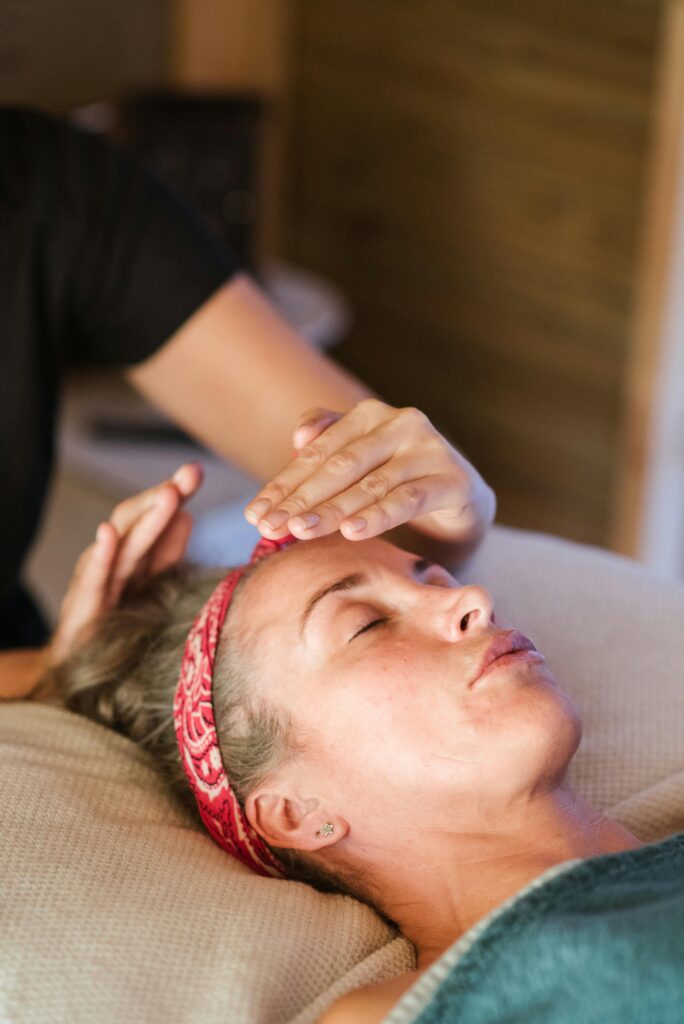
Reiki is a gentle hands-on or hands-near practice that is often used to support relaxation, calm, and a sense of balance in the body.
While forms of energy-based healing have existed in different cultures for centuries, the Reiki I practise comes from the Usui lineage, a Japanese tradition that is now taught and practised around the world.
I was trained in Reiki in Pokhara, Nepal, and that experience became an important part of the path that led me here. It deepened something I had already sensed for some time: support doesn’t always need words to be felt.
People experience Reiki in different ways. Some notice warmth, tingling, heaviness, emotion, or a sense of release through the body. Others leave feeling calmer and more grounded.
At Sounds for Sisterhood, Reiki is integrated gently through the session, either through light touch or with hands just above the body.

Meet Lena
After many years in a fast-paced corporate career, life began to ask something else of me.
There was a time when my body was under significant stress. I wasn’t ready to talk about it, but I knew I needed something gentler.
Over time, what had always been a life of movement and momentum began to soften. I started to learn what it felt like to slow down.
That experience has found its way into everything I offer.
It’s why this work is offered one-to-one. A quiet, private space where nothing is expected of you. Traditional Himalayan singing bowls are played gently around the body, alongside Reiki, allowing each session to remain personal, calm and unhurried.
If you’d like to read more about the path that led me here, I’ve shared more of that journey on my blog.
Why this work is women-centred
Many women move through life carrying a great deal. They are often the ones others rely on, caring for those around them, and continuing on even when their own body is asking for rest. Their own needs are often the first thing postponed.
For those moments when words don’t feel easy, when talking feels like too much, or when what is needed most is simply a place to soften without having to explain.