
For most of my life, I moved quickly. Racing from one moment to the next.
It felt like my body was built for it. Wiry, fast, always in motion.
I was drawn to adrenaline. I raced BMX competitively, logged hundreds of skydives and climbed snow-topped mountains. My photo albums are filled with pictures of me screaming around a roller-derby flat-track or spiralling up a thermal under my paraglider or digging out a snow cave to spend the night in.
And, of course, my career ran at redline. I worked in marketing, climbing to a senior leadership role in a multinational company. Power-walking in high heels, phone glued to my ear, I put out fires all day. Some days, after yet another business flight, I had to remind myself which city I was in.
All this, while completing two post-graduate degrees and raising two (remarkably relaxed and sensible) kids. I ran from moment to moment. Never pausing to look around, to reflect. I wore busyness like a badge of honour. I had to keep running to the next big thing. Never once considering that I may have been running from some big thing.
Burn out
Nervous systems have limits. After years of intensity, mine had reached its.
At first, I didn’t recognise what was happening. I just needed to push harder, I thought. Like many women, I became very good at functioning exhausted. But my health suffered. My body felt on edge, tired in a way sleep couldn’t fix.
It all came to a head in a luxurious apartment in the trendy suburb of Makati in downtown Manila, Philippines. I found myself curled up on the bathroom floor, unable to stop crying, unable to move and utterly without hope. Broken and alone, I sobbed on the floor all day. And the next. And the next. I was 48 years old. I had burnt out.
Learning to slow down
Months later, I found myself walking along a gorgeous beach in Máncora, Peru, with my husband, still wet and cool from our morning swim. I was a long way from Manila now. There was nowhere to be, nothing demanding my attention, no urgency pulling me toward the next crisis. Just the rhythm of the ocean, the warmth of the air, and, for the first time in a very long time, enough quiet to reflect.
I had stepped away from my career to recover. At first, that meant my health. But as the months passed, it became clear that what I really needed was much deeper. I had to rebuild my life.
Somewhere in the stillness I found in Mancora, I began to sense that I needed a different way of being. Something more aligned with my values. A life that allowed space for appreciation, for presence, stillness of expression of my spiritual layer that had always been there, beneath the surface.
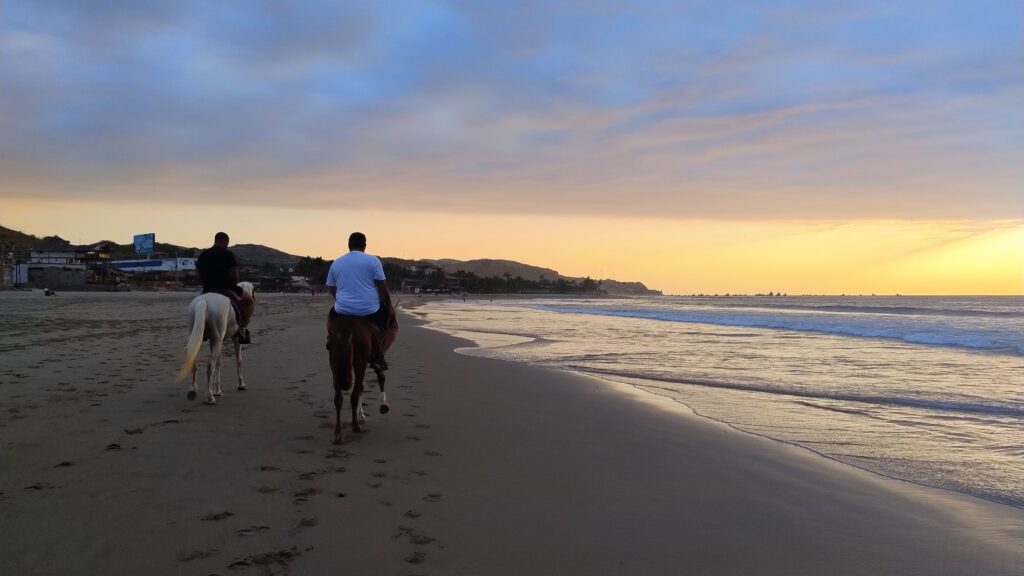
“For decades, I had been moving. Now, I was beginning to learn how to stop.”
At first, it felt unfamiliar. Uncomfortable. But I gave myself permission to rest. To sit without filling the space. To notice what was happening within me, rather than constantly reaching for what came next. And over time something began to shift. I started to recognise myself again, not as the person managing the noise and momentum of a full life, but as someone quieter underneath it all, where nothing needed to be proven and nothing needed to be chased.
I began exploring practices, like meditation, yoga and breathwork. Each helped me reconnect with my body and find pockets of stillness.
My curiosity drew me to more than 50 countries, as I explored the different ways stillness is held across cultures. That path led me deep into the Amazon, where I travelled to a remote village and spent a week in ceremony, searching for a deeper understanding of myself.
I spent many months in India exploring the power of sound. In time, I found my way to the Himalayan Academy of Sound Healing, where I studied Nāda Yoga, the yoga of sound, and was introduced to the bowls that would later become part of my work.
Eventually, I chose my own sound bowls, alongside my teacher, selecting them one by one for tone and vibration.
The first time I sat with my sound bowls, alone, and let their resonance wash through me, I felt my breath slow, my shoulders softened and my mind grow quiet. I felt the last of my perpetual momentum drain away, and, for the first time in decades, I came to a stop. At last, I had found stillness.
Feeling energy move
More recently I became curious about working with energy. It wasn’t new. I had always been attuned to what was happening around me, often picking up on things I couldn’t easily explain.
That sensitivity began early. Growing up in a difficult household, I never knew what I was walking into when I returned home from school or play. I learned to read people and environments quickly. It was a way of staying safe.
That awareness followed me into my career. In the boardroom, it helped me read the room and sense what lurked beneath. My boss used to joke about my “spidey senses.”
I would also absorb other people’s tension and stress. It was as if their fears or anxieties or stresses triggered something in me. I took them on.
I travelled to Nepal to deepen my understanding of working with energy. There, I trained in Reiki under Swami Dhyan Sagar, in the Usui Reiki lineage.
During the training, I felt something move through my body in a way that was unmistakable. It was strong and deeply emotional. A steady sense of energy moving through me, alongside a feeling of openness and stillness that I hadn’t experienced before.
Afterwards, I sat quietly, calm, grounded and deeply present.
Something had shifted and I knew I was learning exactly what I needed. .
Evidence and experience
Back at home months later, I was surprised to find science is looking ever more closely at sound and energy in the healing process.
There is a small but growing body of peer-reviewed research exploring how sound-based practices can influence relaxation and stress responses. The field is still developing but early findings are encouraging.
For me, that mattered. It helped bridge the gap between what I had experienced and what science is beginning to understand.
A moment to rest
Back at home months later, I was surprised to find science is looking ever more closely at sound and energy in the healing process.
There is a small but growing body of peer-reviewed research exploring how sound-based practices can influence relaxation and stress responses. The field is still developing but early findings are encouraging.
For me, that mattered. It helped bridge the gap between what I had experienced and what science is beginning to understand.
I began to wonder what it might feel like for someone else. Someone who was tired. Someone holding more than they realised. Someone who wasn’t ready to talk, but needed a moment to rest.
I know what that feels. To be running on empty. To be disconnected from your own body. To not have the words, or the space, to process it all.
Sounds for Sisterhood grew from a simple intention. Not to fix. Just to give a moment to rest. A calm room. Sound. Stillness. Care. A moment where the body can soften. Where the nervous system can settle, even if just for a moment.
A small circle of care
Through the pay-it-forward model, each paid session helps make sessions available for a woman who may not otherwise have access to this kind of support.
One woman helping another.
Still an adventurer
The transition wasn’t simple. It was rocky at times, and it asked a lot of me. It meant letting go of an identity I had carried for most of my life and learning to meet myself in a different way.
If I’m honest, I’m still discovering what that looks like. But something has settled. I feel more like myself now than I ever have.
These days, life moves at a gentler pace.
I still love riding my motorbike. That will never change. I’ve just swapped the sports bike for a cruiser. A little less speed. A little more ease. A life that still holds adventure, just with stillness woven through it.