If you’ve ever looked into sound sessions, you’ve probably come across two common types of instruments: crystal singing bowls and Himalayan singing bowls.
They’re often spoken about as if they’re interchangeable. But in practice, they can create very different experiences.
This isn’t about one being better than the other. It’s about understanding what each offers, and noticing what feels right for you.
The Sound Itself
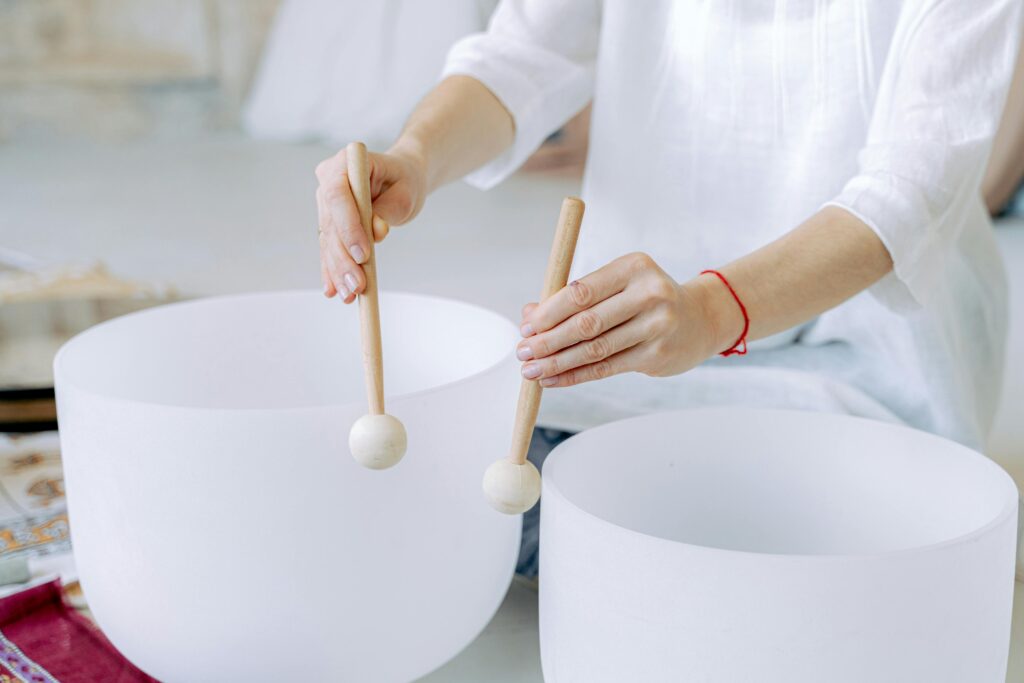
Crystal bowls are made from quartz and tend to produce a clear, stable tone. The sound is often bright, consistent, and sustained, with a strong fundamental pitch and relatively simple overtones.
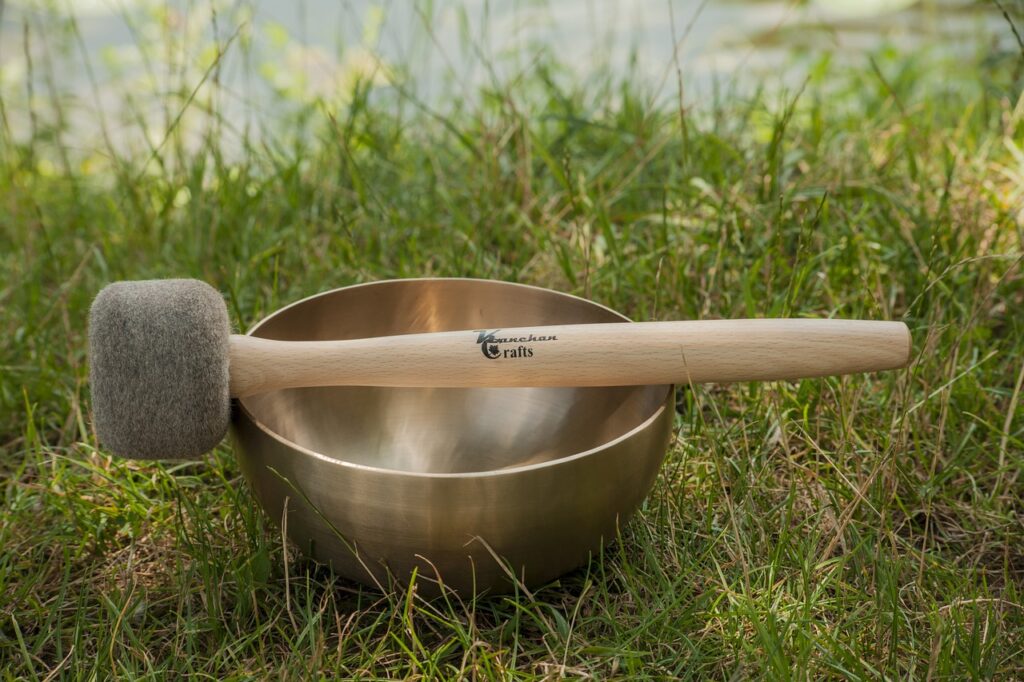
Himalayan singing bowls, traditionally hand-hammered from metal alloys, create something quite different.
Rather than a single dominant tone, they produce layered, complex overtones that shift as the bowl continues to resonate. The sound can feel less fixed, more textured.
These vibrations can often be felt as gentle waves throughout the body.
The role of frequency and tone
You might hear sound described in terms of frequency, or “Hz”.
Both crystal and Himalayan bowls can produce a wide range of frequencies, depending on their size and how they are played. The difference isn’t that one is always higher or lower than the other.
It’s more about how the sound is structured.
Crystal bowls tend to emphasise a clearer, more singular tone. Himalayan bowls produce multiple frequencies at once, creating what is often described as harmonic complexity.
Instead of a steady, linear tone, the sound can feel more like a subtle ripple, with different layers interacting over time.
Many people notice this difference not just in what they hear, but in how the sound is experienced.
How the body experiences it
Crystal bowls are typically played around the body, often in group settings. The sound fills the room and creates a shared, immersive experience.
Himalayan bowls are often used in a more localised way, played closer to the body so the vibration can be felt more directly.
In a one-to-one setting, many people experience this as a quieter, more contained session.
Less about being surrounded by sound, and more about being gently met by it.
While individual experiences vary, some small studies have observed that sound-based practices, including singing bowls, may be associated with reductions in tension and improvements in mood (Goldsby et al., 2017).
Why I work with Himalayan singing bowls
When I first experienced Himalayan bowls, what stayed with me wasn’t just the sound, but the way it felt.
Less like something happening around me, and more like something gently moving through me.
There was a depth to it. A softness.
A sense that nothing was being asked of me.
That experience shaped what I now offer.
A quiet, individual experience
In my sessions, Himalayan singing bowls are used alongside Reiki in a one-to-one setting.
It’s not about performance or immersion.
It’s about creating a space where nothing is required of you.
Just lie down. Breathe. And allow your body to settle in its own time.
If you’re drawn to a group experience
Not everyone is looking for a one-to-one session.
For some, it can feel easier to arrive, soften, and receive in a shared space.
If that feels more like you, Soul Tribe Studio offers group classes and gatherings here in Batemans Bay, on Yuin Country, that include sound, meditation, and other slower, grounding practices.
It’s a genuinely welcoming space, guided by teachers who are warm, approachable, and deeply respectful of wherever you find yourself on the day.
A beautiful place to explore if you feel drawn to shared rest, shared stillness, and the comfort of not having to do it alone.
Final thoughts
Both crystal and Himalayan bowls have their place.
Some people are drawn to the clarity and expansiveness of crystal bowls.
Others prefer the depth and subtlety of Himalayan bowls, especially in a one-to-one setting.
Neither is right or wrong.
Just different ways of working with sound, and different ways of coming back to yourself.